

Product redesign for software that's outgrown itself.
Fix what's in the way. Keep what works.
A product redesign rebuilds how an existing app, portal, or platform works for the people who use it, without throwing away the parts that already do their job.
For products that work, and wear people out.
Most software that needs a redesign isn't broken. It grew one feature at a time until nobody could find anything. This is a good fit if any of these sound familiar:
Calls to support
Customers call support for things the product is supposed to let them do themselves.
The real spreadsheet
Your team keeps the real process in spreadsheets, because the tool can't hold it.
Two different companies
The app and the website look like they came from different companies.
Slower every release
Every new feature takes longer than the last, because nothing underneath is consistent.
The old business
The business has moved on, and the product still describes the old one.
It works for customer-facing apps and portals, and for the internal tools your teams live in all day.
Four things we look at before changing anything.
- I.
The people
Who uses it, in every role, and what they're trying to get done. We watch real work, not just read tickets.
- II.
The structure
How the product is organized: navigation, naming, where things live. Most confusion starts here, not in the pixels.
- III.
The moments that matter
The handful of flows that carry the business: signing up, paying, getting help, finishing the job. Those get fixed first.
- IV.
The system underneath
Components, patterns, and code. What can be kept, what should be rebuilt, and what a design system would save you.
We plan how the redesign rolls out too, so nobody's work stops while it happens.
Keep what works. Fix what doesn't. Add what's missing.
Then we package it so your team can keep building.
01Audit and plan
What's working, what isn't, and why, with the fixes ranked by impact and effort. You get this in week two, and it's useful even if you stop there.
02Redesigned flows
The moments that matter, redesigned and built as working software, and validated with the people who use them.
03Design system
One set of components and rules across web and mobile, so the product stays consistent after we leave.
04Build handoff
Pull requests with live previews, or a spec for your engineers, with design QA through implementation.
All of it is yours. Carry on with your own team, with a partner, or with us.
Start a conversationAn audit first. Then phases.
- 1Weeks 1-2
Audit
We walk the product through every role's eyes, talk to the people who use it and the people who support it, and review the structure and the system. You get findings and a ranked plan.
- 2Each phase
Redesign
Each phase takes one part of the product, usually four to six weeks. We design and build together, test with real users, and end with something working.
- 3Throughout
Roll out
Changes ship in slices alongside the product you already run, with design QA until what's live matches what was designed.
What we need from you
A product owner who can make decisions, access to real users in each role, read access to the product and its analytics, and an engineer who knows the current system.
We've redesigned products people depend on.
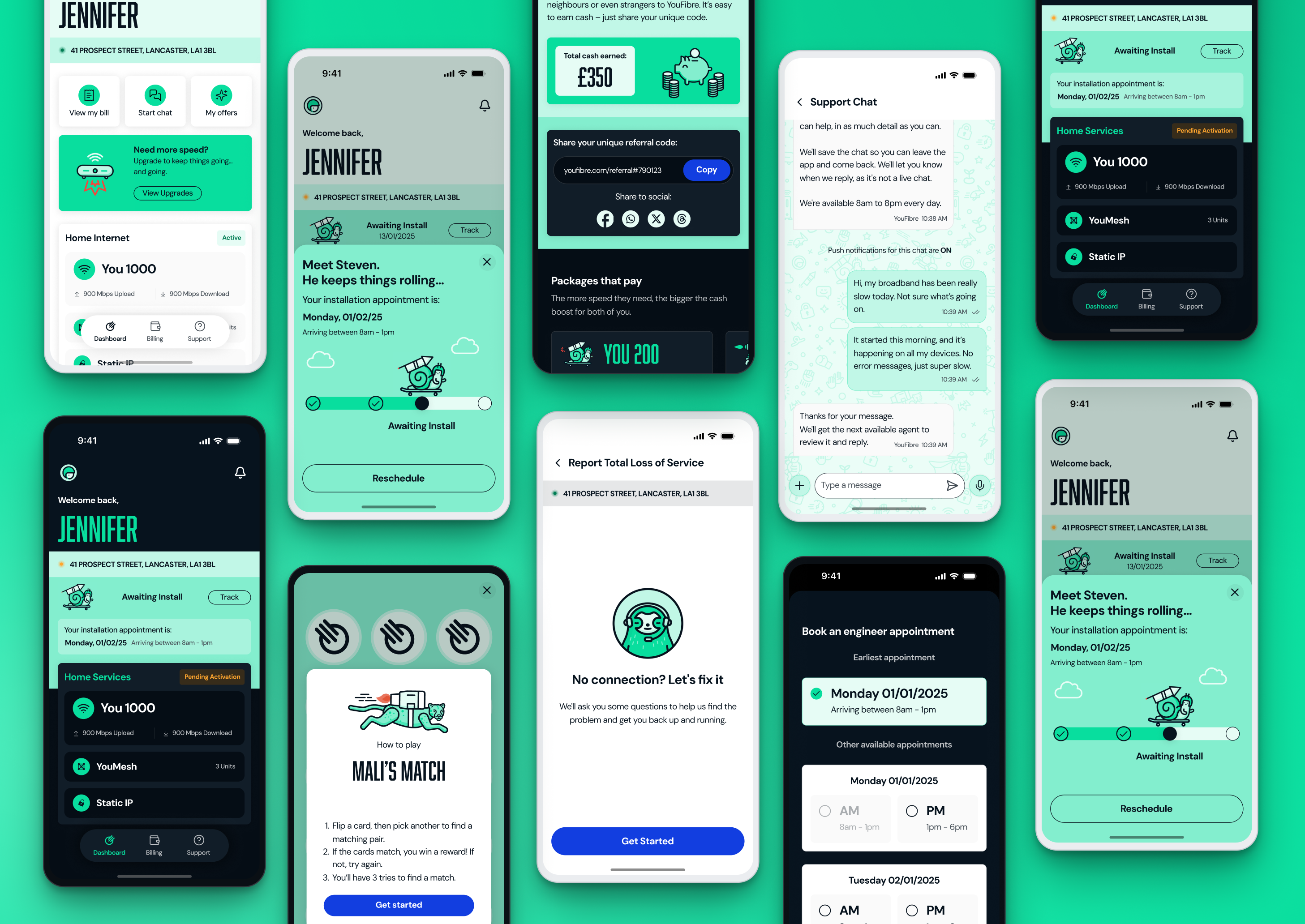
YouFibre runs a 10Gbps fibre network across more than 90 UK towns and cities, with a digital experience that hadn't kept up. We redesigned the mobile app, the customer web, and the internal tools together, informed by testing with more than 100 customers.
What is a product redesign?
It's a rebuild of how an existing app, portal, or platform works for the people who use it: the structure, the key flows, and the design system underneath, while keeping the parts that already work.
Should we redesign or rebuild from scratch?
Usually redesign. Most products have parts that work and data nobody wants to migrate twice. The audit tells you which parts to keep, and if a rebuild really is the better call, we'll say so.
How long does it take?
The audit takes two weeks. After that it depends on the size of the product: each phase runs four to six weeks and ends in something working.
What does it cost?
The audit is a fixed fee. Each phase after it is scoped and priced before it starts, so you're never committed further than the next phase.
Can we just do the audit?
Yes. It stands on its own, and the plan is yours to run with.
Do you work with our engineers?
Yes. We work in GitHub alongside them, in pull requests with live previews, and stay through implementation for design QA.
Will our users have to relearn everything?
No. Changes ship in slices, the flows people use most are tested with them first, and nothing changes just to look new.
Do you redesign internal tools too?
Yes. A lot of our work is on tools customers never see: maintenance platforms, operations dashboards, and support tooling.