
AI product design for features people trust and use.
Design the AI feature before you build the wrong one.
AI product design is the work of deciding what an AI feature should do, how people will steer it, and what keeps it accurate and on-brand, then proving it against a real model before engineering commits.
For teams with an AI feature on the roadmap and no pattern for it.
Designing for a model is different from designing a screen. The output changes every time, and it can be wrong with total confidence. This is a good fit if any of these sound familiar:
A feature, no pattern
You know which AI feature you want, and you're not sure how people should interact with it.
A demo nobody uses
Engineering has a demo that works, and the people it's for don't know what to do with it.
Users who don't prompt
Your users have never written a prompt, and they shouldn't have to.
One wrong answer
One wrong or off-brand answer in front of a customer would be a real problem.
Assessment done
You've finished an assessment and you know what to build first.
If you don't know yet which feature is worth building, start with the AI readiness assessment.
Four things an AI feature has to get right.
- I.
The job
What the person is trying to get done, and where a model really helps with it. The feature serves the task, not the other way around.
- II.
The controls
How people steer it. Often that's buttons, examples, and sensible defaults, not an empty prompt box.
- III.
The wrong answer
Models miss. We design what happens next: regenerate, edit by hand, hand off to a person, or fall back to something safe.
- IV.
The guardrails
Brand voice, facts, and what's off limits, built into the system so they hold without anyone having to remember them.
We design how it gets adopted too: onboarding, training, and the first weeks after launch.
Five things your team can build from.
01Experience design
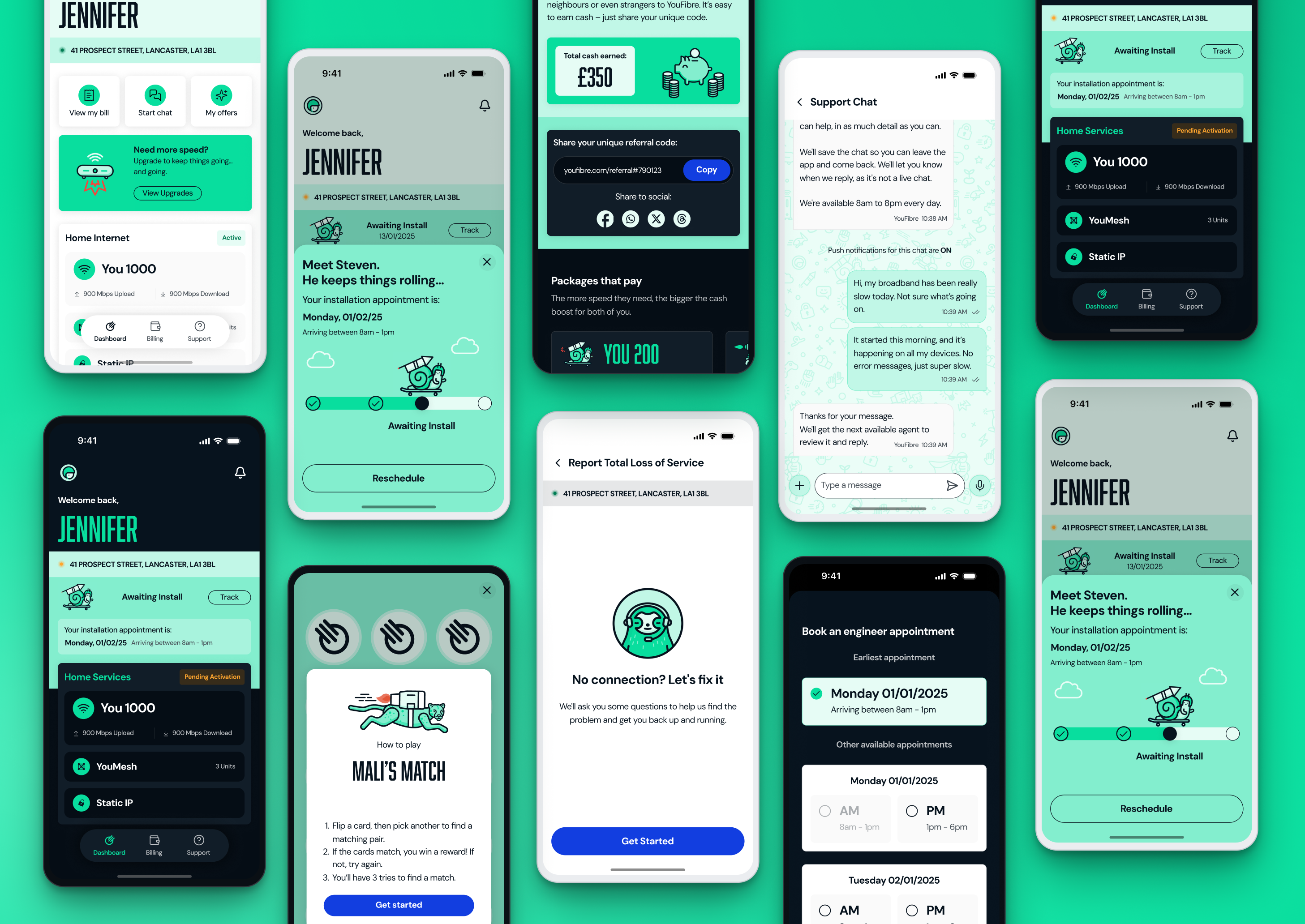
Flows, screens, and every state, including loading, uncertainty, and failure. Designed in your brand and your design system.
04Evaluation set
Real test cases and a way to score them, so you can tell whether quality is holding before launch and after every change.
05Build handoff
A repository and a written spec your engineers can pick up. We work in pull requests with live previews, so nothing gets lost in translation.
02Guardrail spec
What the model may say and do, what it may not, where a person reviews, and what happens when it's unsure. Written as rules a system can check.
03Tested prototype
A working version with a real model behind it, put in front of the people it's for. We change it based on what they do, not what they say.
01Experience design
Flows, screens, and every state, including loading, uncertainty, and failure. Designed in your brand and your design system.
02Guardrail spec
What the model may say and do, what it may not, where a person reviews, and what happens when it's unsure. Written as rules a system can check.
03Tested prototype
A working version with a real model behind it, put in front of the people it's for. We change it based on what they do, not what they say.
04Evaluation set
Real test cases and a way to score them, so you can tell whether quality is holding before launch and after every change.
05Build handoff
A repository and a written spec your engineers can pick up. We work in pull requests with live previews, so nothing gets lost in translation.
All of it is yours. Build it with your own engineers, with a partner, or with us.
Start a conversationSix to eight weeks, in three stages.
- 1Weeks 1-2
Frame
Who it's for, what job it does, what the model needs to know, and what could go wrong. We agree on what good looks like before designing anything.
- 2Weeks 3-5
Design and prototype
We design the experience and build it against a real model at the same time, so we're judging real output, not placeholder text.
- 3Weeks 6-8
Test and hand off
Sessions with real users, guardrails tuned against what we see, then the evaluation set and the handoff to whoever builds it.
What we need from you
A product owner who can make decisions, access to the people the feature is for, the content or data the model will draw on, and an engineer we can talk to about what's feasible.
We've done this where the stakes were real.
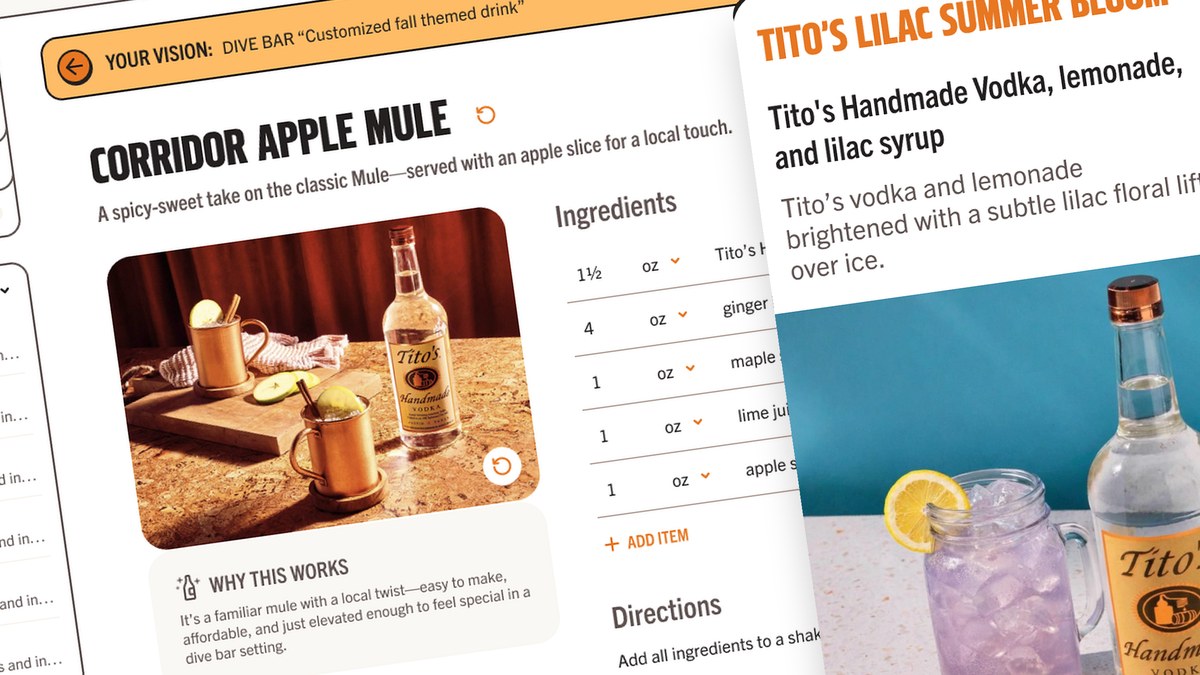
A national spirits brand asked us to design a generative AI mixologist for its 400-person sales team, with no room for off-brand output and users who had never written a prompt. It launched in under a year and is in the field today.
What is AI product design?
It's the design of products and features that use AI models: what the feature does, how people steer it, what happens when the model is wrong, and the guardrails that keep it accurate and on-brand.
How is it different from regular product design?
The output isn't fixed. A model can give a different answer each time and can be wrong with confidence, so the design has to cover uncertainty, review, and recovery, and it has to be tested against a real model, not mockups.
How long does it take?
Six to eight weeks from kickoff to a tested, build-ready design. Bigger features can run longer, and we'll say so before we start.
What does it cost?
It's a fixed fee, agreed before we start. Tell us about the feature and we'll send you the number.
Do you build it too?
We prototype with real models and we can ship production front-end. For complex systems we work alongside your engineers or a partner team we've shipped with before.
Which AI models do you work with?
We're not tied to one. We prototype with whichever model fits the job and your constraints.
Do we need an AI readiness assessment first?
No. If you already know what you want to build, start here. If you're not sure which idea is worth it, the assessment answers that in three weeks.
How do you keep the output on brand?
By building the rules into the system: what the model is given, what it's allowed to return, and what gets checked after it generates. A style guide on its own doesn't hold.